
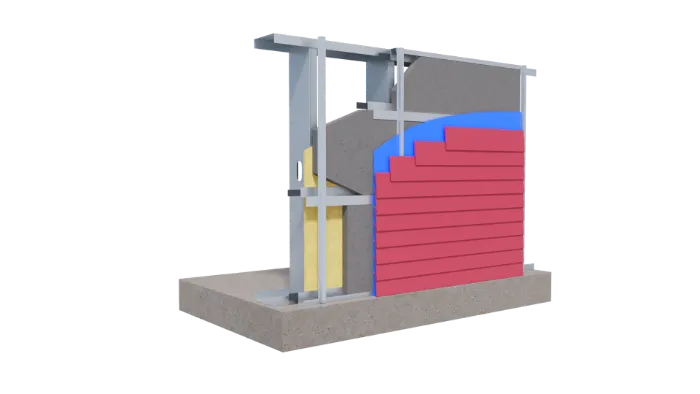
Energy codes have quietly rewritten the exterior wall. What used to be a simple assembly of studs, sheathing, and cladding now has to carry one to four inches of continuous rigid insulation on the outboard side of the framing. That layer solves a real thermal problem, but it creates a practical one: how do you hold the foam in place, and how do you attach cladding through it, without giving back the performance you just paid for?
ThermaFast® from The Steel Network answers both questions with a single engineered system. It replaces improvised details and long cantilevered fasteners with purpose-built J-Track, Z-Track, and corner angles that lock the foam in place and give the cladding something solid to land on.
The Thermal Bridging Problem Behind Modern Steel Stud Insulation
Steel is an excellent structural material and a very poor thermal one. A cold-formed steel stud conducts heat roughly 400 times faster than wood, which means every stud in the wall behaves like a small radiator bridging the interior and exterior.
The numbers are stark. R-19 batt insulation installed in 2×6 steel studs at 16 inches on center delivers an effective assembly value of roughly R-7.1, a loss of about 63 percent. The same batt in wood framing loses only 14 to 18 percent. Cavity insulation alone simply cannot carry a steel-framed wall to code.
This is why the IECC and ASHRAE Standard 90.1 now require continuous insulation on most commercial exterior walls. Continuous insulation sits outboard of the framing, unbroken by studs, so it insulates the thermal bridge rather than working around it. Wall stud insulation in the cavity still contributes, but the continuous layer is what makes the assembly numbers work.
The catch is attachment. Rigid foam has no structural capacity. Left unsupported, boards slide, bow, and pop out of plane during installation and over time. And cladding fastened through three or four inches of foam with long screws alone relies on a cantilevered connection that deflects under load. Designers have been solving this with one-off details for years. ThermaFast standardizes it.
What ThermaFast Is
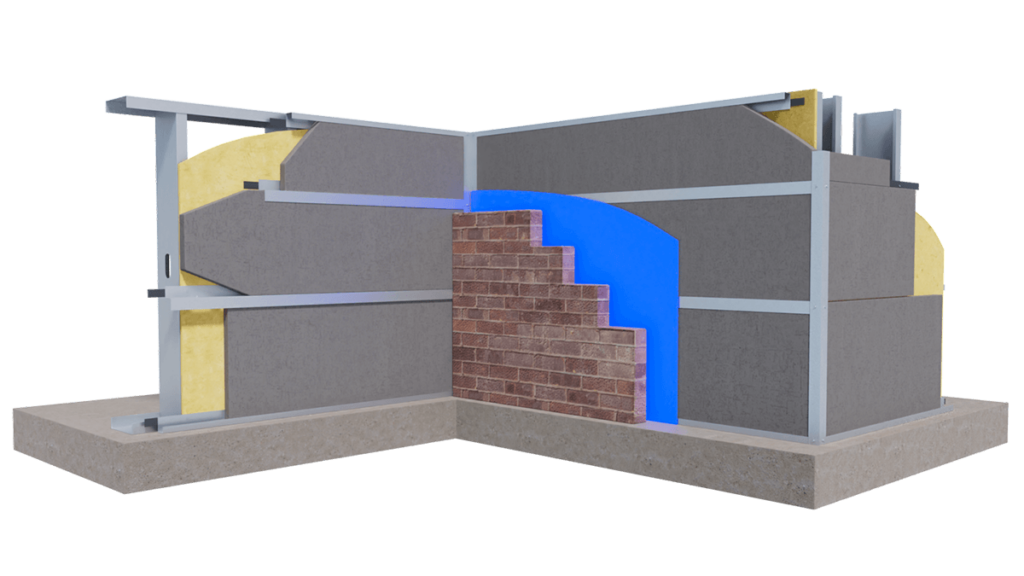
ThermaFast is a system of galvanized steel tracks and angles that install horizontally at each layer of rigid foam on an exterior metal stud wall. The components fasten directly through the sheathing into the studs with typical self-drilling screws. No specialty fasteners, no proprietary tools.
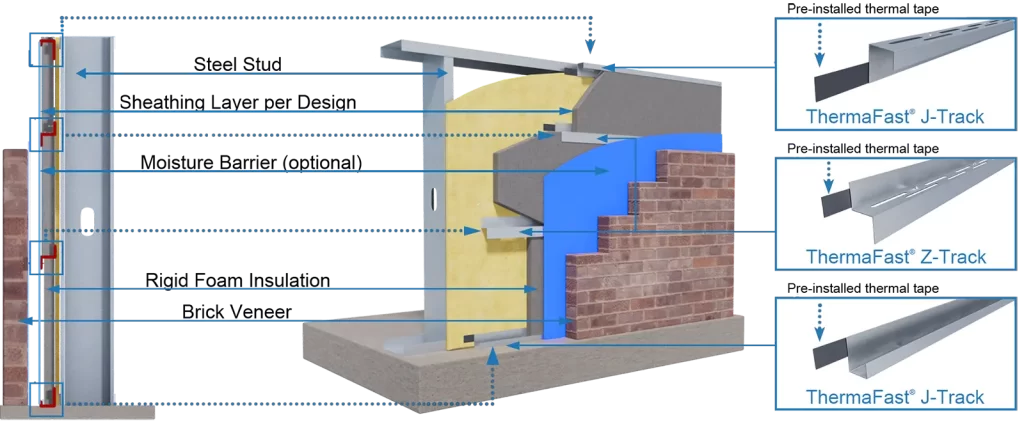
Three parts do the work:
- J-Track (100JT through 400JT) — used at the base and head of the wall, sized for 1″, 1.5″, 2″, 3″, and 4″ foam depths
- Z-Track (100ZT through 400ZT) — used at intermediate layers, in the same foam depth range
- Corner Angles (200CA series) — 2″ leg length, used to terminate and tie the horizontal members at corners
All components are manufactured from ASTM A1003/A1003M Structural Grade 50 (ST50H) steel with a 50 ksi minimum yield strength, in 20 gauge (33 mil) and 16 gauge (54 mil). J-Track and Z-Track ship in 12-foot lengths; corner angles in 10-foot lengths.
Insulation Supports That Actually Hold the Foam
The defining feature of ThermaFast is its foam engagement geometry. Each track is formed to capture the edge of the rigid board rather than merely sit against it. Foam is inserted into the J-Track at the base, a Z-Track is installed on top of it and screwed to the studs, and the next course drops into place. The insulation is mechanically restrained top and bottom, all the way up the wall.
That distinction matters when you compare it to the alternative. Conventional approaches rely on adhesive, washer-plate fasteners, or the cladding itself to keep boards from moving. Adhesives are temperature and substrate sensitive. Plate fasteners create dozens of point penetrations per board and still allow bowing between them. Neither behaves like a true insulation support, and neither provides a continuous line of restraint.
ThermaFast functions as a continuous line of insulation support at every horizontal joint. Whether you specify them as insulation supports, insul stud accessories, or exterior Z-furring, the function is the same: the foam stays flat, stays in plane, and stays where the drawings put it, without a single specialty fastener.
A Stable Substrate for Cladding Attachment
The second job the system performs is arguably more important structurally. ThermaFast provides what the manufacturer describes as a stable component for direct substrate attachment. Rather than running long screws through four inches of compressible foam and hoping the connection holds, cladding and exterior sheathing fasten into a rigid steel member that is itself screwed back to the stud.
The tracks are formed with wide flanges, which increases the screw target area. On a jobsite, that translates directly into fewer missed fasteners, fewer blowouts through the foam, and faster progress for the exterior trades. Installers hitting a wide steel flange work considerably faster than installers hunting for a stud through several inches of insulation.
This also improves the load path. A cantilevered screw through thick foam transfers cladding dead load and wind pressure through an unbraced fastener shank. A track-based connection transfers it through a steel member in bearing. For heavier claddings, brick veneer, cement board panels, metal panels, that difference shows up in deflection performance and long-term serviceability.
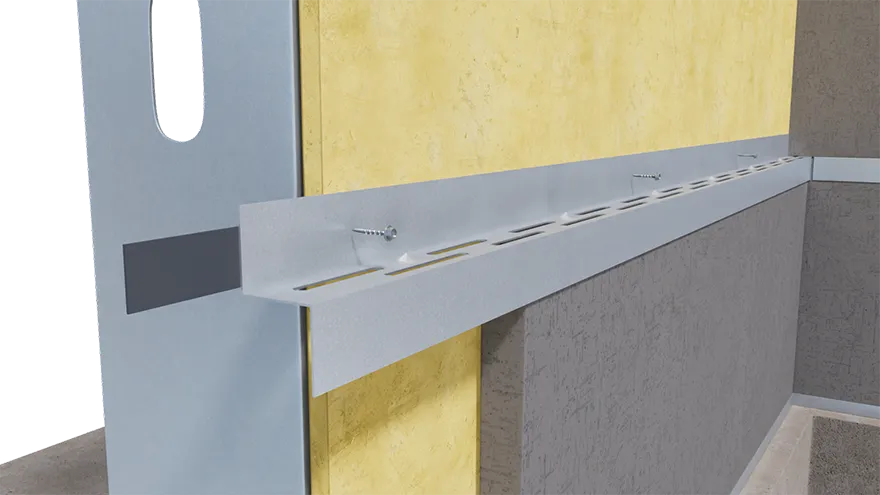
Cladding fastens into a rigid steel member rather than cantilevering through several inches of foam.
An Integrated Thermal Break
Any steel member that penetrates the continuous insulation layer creates a secondary bridge. ThermaFast addresses this with pre-installed thermal tape at the interface between the track and the framing.
The tape is 1/16″ thick with a density of 25 lbs/ft³ and a k-factor of 0.3 Btu-in/hour-ft²-°F. Because it arrives pre-applied, the thermal break does not depend on field labor or sequencing. No one has to remember to install it, and there is no separate line item to price, procure, and inspect. The detail is built into the product.
Documented Assembly Performance
Specifiers do not get credit for nominal R-values. They get credit for assembly performance, which is what energy modeling and code review actually evaluate. The Steel Network publishes tested assembly values for common ThermaFast configurations:
6″ steel stud wall with 200ZT-54 Z-Track:
- 2″ exterior continuous insulation: R-10.67 (U-value 0.093)
- 4″ exterior continuous insulation: R-25.55 (U-value 0.039)
8″ steel stud wall with R-25 cavity insulation:
- 2″ exterior continuous insulation: R-22.18 (U-value 0.045)
- 4″ exterior continuous insulation: R-27.75 (U-value 0.036)
Those last two rows illustrate the strategy well. Adding cavity insulation to a metal stud wall produces diminishing returns because of the bridging penalty. Adding continuous insulation outboard of the framing produces close to its full rated value. The combination of good cavity metal stud insulation and a properly supported continuous layer is what carries a wall assembly comfortably past code minimums.
Corrosion Resistance and Material Quality
ThermaFast components carry an ASTM A653/A653M G90 hot-dipped galvanized coating. G90 is the standard specification for structural framing components in exterior wall applications and provides the zinc coating weight needed for long-term durability inside a wall cavity where condensation is possible.
Because the tracks are made from the same Grade 50 structural steel used elsewhere in the framing system, they are compatible with standard cold-formed steel design assumptions and standard connection hardware. Nothing about the system asks a contractor to work outside their normal scope.
Installation in Eight Steps
The sequence is deliberately simple:
- Install base sheathing per the design
- Install J-Track at the wall base, connecting to each stud
- Insert the 24″ course of rigid foam insulation
- Install Z-Track atop the foam, connecting to studs
- Repeat steps 2 through 4 up the wall
- Before the final course, install J-Track at the head, connecting to studs
- Insert the top row of insulation into the head J-Track
- Install corner angles, attaching to the J and Z tracks
There is no adhesive cure time, no specialty fastener inventory, and no field fabrication. The rhythm of track, foam, track, foam is repetitive in the way that makes crews efficient.
Applications
ThermaFast is designed for metal stud wall insulation on exterior assemblies across a broad range of claddings:
- Brick veneer
- Cement board panels
- Metal panels
- EIFS
- Stucco
- Siding over furring channel
Anywhere the design calls for one to four inches of continuous rigid insulation over cold-formed steel framing, the system applies.
Specifying ThermaFast
Design support is available at the level most project teams need. The Steel Network provides technical spec sheets, downloadable CAD details, BIM models, editable specification documents in Word format, and a LEED v5.0 credit worksheet for teams pursuing certification.
For architects and engineers, the practical benefit is that the continuous insulation detail stops being a custom drawing on every project. It becomes a specified assembly with published performance data, standard part numbers, and a defined installation sequence, which is exactly what a wall detail should be by the time it reaches the field.
Continuous insulation is no longer optional on steel-framed exterior walls. ThermaFast makes it buildable.